
Short Book Reviews #6
Watchmen, Neuromancer, IABIED
Graphic Novels
Invincible
by Robert Kirkland and artists Cory Walker and Ryan Ottley
(I read all 144 issues of it, in three compendiums, more than 15 years worth of work by its writers and artists. It took a couple weeks. There’s something there about the nature of how we experience time, which is funny, because Invincible plays with that a lot too. There are some spoilers in the review, though I’ll try not to spoil anything past season 1 of the show.)
Invincible, popularized recently by the Amazon Prime animation of the comic, is a superhero comic with a lot to say about superhero comics. It’s a deconstruction and a love letter to the tropes, foibles, and trappings of Marvel and DC.
But before all that, it’s the story of Mark Grayson, who decides to call himself Invincible and promptly gets the absolute shit beaten out of him for the next 144 issues.
Mark’s father is Superman, if Krypton had been a galactic empire bent on conquest, sending their sons and daughters to other planets to weaken them from within before conquering them single-handedly.
When Mark gets his powers in his late teens, he finds himself caught between different notions of heroism as he attempts to stay true to his ideals while balancing his father’s brutal might-makes-right with Cecil Steadman’s (Director of the Global Defense Agency and effective boss of superheroes) ruthless pragmatism. Each new threat and challenge push him further along the axis from pure hero to something more grey, and the decisions he makes will shape the lives of quadrillions as an intergalactic war brews in the background.
Oh, also it’s really hard for him to make time for his girlfriend.
I found Invincible to be a thrilling page-turner, with gorgeous (if somewhat functional) art and a cast of characters both deep and diverse. There are all kinds of heroes and villains, and some character arcs go places you’d never guess, while others circle back in satisfying conclusions, having learned powerful lessons along the way.
Then again, I like superhero stories, and deconstructions of superhero stories even more.
If you’re at all a fan of the genre, you’ll find something worth reading here, and plenty of it to read.
Contains: time travel, vague homophobia that the show fixes, the difficulty of maintaining a relationship when the author timeskips you, idealism vs. pragmatism, means vs. ends, a talking dinosaur, and entirely too many mustaches.
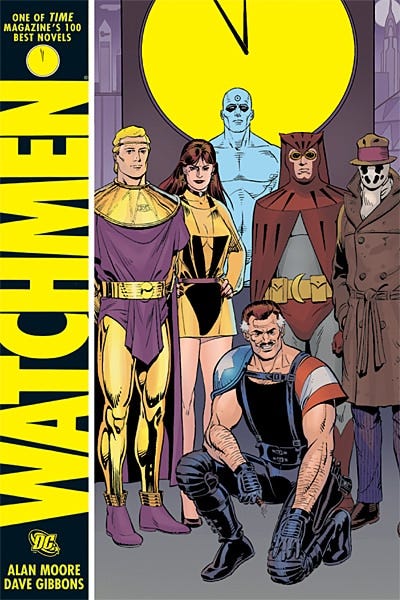
Watchmen
by Alan Moore and artist Dave Gibbons
(Acclaimed as one of the greatest graphic novels of all time, Watchmen is one of those classics that everyone ought to read. I read it. Turns out, the hype is real. It’s actually that good.)
I am in awe of this work.
I think it’s legitimately one of the greatest English-language pieces of fiction ever produced.
The basic premise is that “superheroes” - mostly people with masks - showed up in America in the 30s, followed by a second wave in the 1960s. It’s now the late 1980s, masked vigilantes are outlawed, the lone super-powered person - Doctor Manhattan - is a key piece of American military might, and the Cold War is ever on the verge of turning hot.
Then an old crimefighter named The Comedian is murdered in his home, starting an investigation by the last remaining active superhero, the sociopathic Rorschach, which leads him into a conspiracy beyond the works of any supervillain the heroes had ever faced.
Poetic, beautifully illustrated, deeply thematic and ponderously dense, Watchmen defies easy description. It’s about people and nations and heroes and villains, law enforcement and law breaking, how the past creates the future, how love can be a force for good and a force for ill, how…
You get the picture. There’s a lot.
What was interesting to me, while reading, was that I’m a fan of the Zach Snyder film adaptation, and how shockingly true to the graphic novel it is. There are a few details changed and one particular thread omitted, but on the whole the movie really is as faithful to the original as I think a movie can be.
Watchmen is literature. I felt things reading it. I learned things. I knew exactly what would happen and it was still a masterpiece.
Contains: hyper violent imagery, sex, Dr. Manhattan’s carefully covered genitalia, a raft made of bloated corpses, ads for action figures, schoolboy heroics, a depressed psychotherapist, sexual violence, the political opinions of a man running a news stand, and lots of inconvenient tachyons.
The Hobbit
by J.R.R.Tolkien, illustrated by David Wenzel
(Seemed interesting, especially since I can’t remember the last time I read the book. It was, all told, a very faithful recreation.)
For all three of you who don’t know, The Hobbit is the tale of Bilbo Baggins, a short creature called a Hobbit, as he is taken on an adventure to help a group of dwarves reclaim their mountain from the dragon Smaug.
Along the way, they come across talking spiders, dull trolls, prideful elves, vast riches, lake people, and more, as Bilbo finds his courage and wits as he is forced to save the party again and again.
This graphic novel was a faithful and well-illustrated depiction of the novel. If you’re into The Hobbit and graphic novels, it’s worth a read.
Contains: hairy feet, wizards who are always on time, greedy dragons, black arrows, and riddles in the dark.
Fiction
Exhalation
by Ted Chiang
(A collection of short stories from the author of the story that became the movie Arrival, this is a delightful mix of science fiction and philosophical musing.)
Ted Chiang’s short stories embody what I find so wonderful about science fiction: the extrapolation of an idea to its logical conclusion, giving us a glimpse of worlds that might be or have been.
The title story is about air-powered androids contemplating the end of their universe in entropic stillness, as the energy they get from air pressure comes from a pressure differential, and that differential is equaling over time.
Another story is about a world, near ours, where personal cameras are ubiquitous and an AI company makes your entire life’s footage instantly searchable. This is a world where memory itself is being outsourced, and is written as a newspaper article by a journalist struggling with the implications. The new technology is compared to a real historical case of when the written word was introduced to an African tribe, and the author of the article must wrestle with the startling personal implications of what knowing the actual truth of every memory entails.
Overall, I found this collection delightful, and would recommend.
Contains: humans without belly buttons, auto-brain-surgery, AI pets
A Hole In Space
by Larry Niven
(A collection of short stories from a famous science fiction author, mostly about the JumpShift, a teleportation booth that becomes common on Earth, and how it changes things.)
What would the world look like, if everyone had a booth in their house that could transport them anywhere else on the planet instantly?
Well, for one, there’d be a lot more murders.
A Hole In Space is excellent science fiction, in that, as Frederik Pohl said, "A good science fiction story should be able to predict not just the automobile but the traffic jam." Niven doesn’t concern himself too much with the details of how it works, only enough to add to the story when it matters - he’s far too busy exploring how such technology would revolutionize daily life. All of a sudden, commutes are instantaneous. People can live anywhere.
Someone can commit a murder in New Zealand and be sipping Mai Tais in California the next minute.
The collection also explores solar sails and interstellar trade, always with an eye for scientific accuracy and human ingenuity.
Contains: murder, investigation, heat differentials, really fucking convenient technology I’d love to have no matter how much murder it enables.
The Anarchistic Colossus
(I was expecting a giant that didn’t follow the rules, and I got a metaphor for society. I admit to being slightly disappointed.)
What would it take, for humans to have a civilized society without any kind of government? How could property (which is supposedly nine-tenths of the law) reamin one’s own, if there’s no consequences for stealing?
The answer that ___ presents is the Kirling, a massive distributed computer system that can accurately understand a human’s emotion just from seeing them with its ubiquitous cameras and fire a laser beam that renders anyone unconscious whenever they act with malice towards another human.
(…I’m not sure this solves certain kinds of collective action problems or negative externalities like pollution or existential risk, but it makes for an interesting sci-fi novel.)
Interestingly enough, ___ is interesting in exploring the same issue I am, because he challenges this society he’s dreamt up with something it really shouldn’t be capable of handling: an alien invasion.
The novel is told largely from the perspective of an alien, playing a ‘game’ (as its species often does) involving the destruction of another species. The alien thus follows along the main characters as they awaken to, and attempt to prevent, the alien armada rapidly approaching Earth.
It’s a strange little novel, not amazing, not bad, just weird in that sci-fi way of taking a premise and really engaging with it. It’s very competently executed, even though the writing wasn’t quite to my tastes.
Contains: lasers that make you unconscious, The System, a romance that feels like an afterthought, being Shanghaied, an absolute lack of sexual violence that somehow wasn’t as reassuring as I wanted it to be, and spaceships.
Neuromancer
by William Gibson
(Often hailed as the progenitor of the Cyberpunk genre, Neuromancer is a sci-fi classic that I had to read eventually. It’s always a little strange, experiencing a progenitor after having already seen the content it generated, like watching John Carter after Star Wars or Neuromancer after Cyberpunk: Edgerunners. You see the genesis of so many ideas, but in a lot of ways the later versions are more refined, more fleshed out. Better.)
Case is a computer cowboy, someone who jacks in to the matrix (no, not that Matrix) and surfs the digital waters. A deal gone wrong has left him alone, slinging drugs to make ends meet after his nervous system got wrecked by poison.
But Case’s story isn’t over: a stranger called Armitage, backed by the enigmatic Wintermute, has offered to repair Case’s nervous system so he can help them with one last job: hack an unhackable AI.
If ever there was a case of style over substance, this is it. Neuromancer is the progenitor of the Cyberpunk genre, and the bones of it are clearly here: a techno-corporate dystopia, hacking through ICE to penetrate computer networks, visualizations of the internet (including calling it The Matrix well before the movie came out), vague references to off-planet shenanigans while the protagonist is stuck in the gutters, Night City, and more.
The actual plot is okay, but it didn’t really grab me a whole lot, mostly because it was difficult to connect to the characters. Case is an apathetic addict, and while Molly (the samurai who handles the physical tasks while Case handles cyberspace) is awesome, she’s also the poster child for Emotionally Distant. It was hard for me to tell if Case, Molly, or anyone else actually changed or grew as the plot progressed; this is definitely not a character-driven story.
That being said, it’s worth a read for the atmosphere alone. And who knows, maybe I’ll reread it in the future and have a completely different opinion.
This is a novel that sticks with you like the oil slicks slowly oozing into the gutters of a rain-soaked neon street, while hydrogen concertos sound in the distance and the pulse of the Matrix calls.
Contains: intense body modification, an AI actually being as dangerous as an AI should be, poison, politics, death, drugs, zero G, Rastafarians, bodily fluids, sex, and more imagery than you can find in your electric dreams.
Fourth Wing
by Rebecca Yarros
(My sister recommended this one to me for a number of reasons. It’s considered to be a very central example of the modern ‘romantasy’ novel, which (from what I can gather) basically means there’s violence and sex in a fantasy setting, with the emphasis on the sex.)
Violet Sorrengail is probably going to die.
Why?
Because her mother forcibly enrolled her in a college that kills three-fourths of its students by graduation.
Also she’s got Ehler’s Danlos.
Also there are dragons.
Welcome to Basgiath War College, where the rivalries are heated, the dragon fire is scorching, and the sexual tension is molten. Welcome to Fourth Wing.
Rebecca Yarros gives us a passable fantasy world with magic and dragons, and although I was left with plenty of questions about how the world works, none of that really matters.
What really matters is that Xaden Riorson also goes to Basgiath War College, Violet’s mother killed his whole family, and he’s also the hottest guy Violet’s ever seen and she wants to climb him like a tree.
If you’re coming to this book for action and danger, well, it’s got some of that. If you’re coming for mystery, strategy, or politics, well, there’s a sprinkle of each here and there.
But in the end, everybody’s here for the romance, we all know it, let’s not kid ourselves. And in that regard, the novel does well. I think the whole thing is a bit schmaltzy, but to be honest that’s the genre we’re in. People’s feelings and whether or not Xaden is fucking Imogen are the real issues, while little things like not falling off your dragon mid-flight and murder attempts are mere distractions or opportunities for Xaden to show off how much of a thoughtful hottie he is.
If this is your jam, go for it, and enjoy yourself. I did.
Contains: corsets, a childhood best friend, Actually Getting The Distinction Between Dragons and Wyvern Right, knives, a very ineffective method of culling prospective dragon riders, more knives, Violet’s joints not staying in place, a shadow-wielding hottie, even more knives, underdeveloped friendships because seriously, Xaden is like so hot, Dragons Not Giving A Fuck, Violet being super special and awesome, and just all the knives.
Nonfiction
If Anyone Builds It, Everyone Dies
(The official book covering the rationalist’s argument for why AI is going to kill us all, likely within the next five years. I’ve already engaged with all of the material before, but this was in many ways the most streamlined version of the argument, designed for normies. If it accomplishes what it sets out to do, it could very well be the most important book ever written in human history.)
If anyone anywhere builds artificial intelligence that surpasses human intelligence, with anything like current methodologies, everyone everywhere dies.
That is the core of this book, and I personally believe that it is correct.
There are a number of pieces to this argument over which much ink, both literal and metaphorical, has been spilled, but it comes down to this:
Modern AI are grown, not crafted. We have no idea why they act the way they do, or how they work the way they work.
We do not possess the ability to reliably make these AIs we’ve grown want any specific thing, in the normal human sense of the word want (have a desire for and act in the world to accomplish). (This is called the Alignment Problem.)
These AIs are getting more and more powerful, and soon they will be sufficiently powerful to make more powerful versions of themselves (recursive self-improvement). Note that a) although this sounds like science fiction, it’s actually how the computer industry has behaved for more than 50 years, with faster computers being used to build even faster computers, and b) CEOs of modern AI companies, including OpenAI (maker of ChatGPT) and Anthropic (maker of Claude) expect this to happen within five years at the most, and are actively attempting to make it happen within three.
Exactly what happens after super-powerful AI, sometimes called ASI (artificial super intelligence) arrives cannot be predicted, but human extinction is a virtual certainty, given that whatever goals this ASI ends up with, it can always accomplish them better without humans present than with humans present. (You might say: unless its goal is to serve humans or keep them happy or whatever, to which the response is: that would be neat, except as per 2. above we can’t guarantee that.)
So the only winning move is not to play.
There’s a lot more to it, but to be blunt, this is worse than the Cold War’s nuclear standoff and Mutually Assured Destruction, because at least with nukes everybody knew everyone would die if anyone started the war. Whereas with AI, everyone seems convinced that they have to succeed before everyone else, and are making shitloads of money in the attempt, so…
Yeah.
If you read one book from my recommendations and are on the fence at all about this, or if you’ve never thought about it before, please check it out.
Contains: lots of parables, a growing sense of doom, authors who would really rather they were wrong about everything but are confident that they aren’t, descriptions of engineering disasters and what we can learn from them, and a glimmer of hope in the darkness.
CPTSD: From Surviving To Thriving
by Pete Hesgeth
(I was told by some therapist friends that, in the field of the psychology of trauma, The Body Keeps The Score was Trauma 101, and CPTSD: From Surviving To Thriving is the next text, something like Trauma 201. I was curious, so I kept reading. )
This is a strange book.
It’s something of a self-help book, written by a therapist with the condition he’s getting you to help yourself with. It’s broken up into very short segments, and covers a wide range of topics related to CPTSD. For those who’ve never come across the term before, Complex PTSD is the term for PTSD that tended to originate in childhood from a form of abuse, although there are other ways to get it. It goes far beyond PTSD’s flashbacks to include a complete warping of one’s entire life around the trauma one endured.
Hesgeth devotes a great deal of time to how CPTSD shows up in various ways, depending on a person’s 4F response: fight, flight, fawn, or freeze. He explains how these responses metastasize, creating an Inner Critic that constantly degrades and insults the sufferer, along with how to shrink the Inner Critic slowly over time.
The book often mentions case studies and other stories from Hesgeth’s life and practice, concretizing his theories via Hesgeth’s compassionate voice.
It’s a difficult book to get through, but if you have unresolved issues from childhood or otherwise feel that you’re self-sabotaging, it’s worth a read. As with all self-help books, take what works for you and leave the rest.
Contains: Depictions of abuse, mental health struggles, optimism.
Walker --> Hegseth